Unseen Kanazawa: Where Tradition Whispers in Hidden Corners
Nestled on Japan’s rugged coast, Kanazawa is a city that quietly guards centuries of culture behind unassuming doors. Far from the neon buzz of Tokyo or the temples of Kyoto, it reveals its soul in subtle moments—steamed tea in a centuries-old teahouse, the hush of a private garden at dawn, hands shaping gold leaf in near-total silence. This isn’t just travel—it’s slow immersion. And if you know where to look, Kanazawa shares secrets most tourists never hear. With its well-preserved Edo-era districts, living craftsmanship, and serene natural beauty, the city offers a rare kind of journey: one where history isn’t performed but lived, where every alleyway and artisan carries forward a legacy that time has gently protected.
The Allure of Kanazawa: More Than a Kyoto Sidekick
Kanazawa is often described as a quieter cousin to Kyoto, a miniature version of Japan’s ancient capital. While the comparison is natural—both cities boast preserved wooden machiya houses, geisha traditions, and imperial gardens—it does a disservice to Kanazawa’s unique identity. Kyoto, with its grand temples and bustling tourism infrastructure, often feels like a stage where history is performed for visitors. Kanazawa, by contrast, never left the script. It is not a reconstruction or a revival. It is continuity. The city escaped major damage during World War II, allowing its historic neighborhoods to remain intact, not restored. In Nagamachi, the former samurai quarter, stone-paved lanes and thick earthen walls have not been preserved for display—they are still part of daily life. Families reside in ancestral homes, and the rhythm of the past continues in the present.
What sets Kanazawa apart is authenticity rooted in resilience. While other Japanese cities were rebuilt with concrete and steel, Kanazawa retained its low-rise skyline and traditional urban fabric. The Maeda clan, once among Japan’s wealthiest feudal lords, ruled the region for over 300 years, fostering a culture of refinement that endures today. Their legacy lives not only in museums but in the way locals speak, craft, and gather. There is no need to recreate the past when it has never truly ended. This makes Kanazawa not just a destination, but a sanctuary for those seeking depth over spectacle. For travelers weary of crowded attractions and staged performances, Kanazawa offers something rarer: the chance to witness culture as it unfolds naturally, in real time, behind unmarked doors and down quiet alleys.
The city’s identity is also shaped by its geography. Located on the Sea of Japan, Kanazawa is sheltered by mountains and influenced by heavy winter snowfall, which historically limited outside contact. This isolation nurtured a self-contained cultural ecosystem where arts, cuisine, and craftsmanship evolved in relative independence. Even today, the local dialect and culinary specialties—like jibuni, a rich duck stew simmered in sweet soy broth—remain distinct from mainstream Japanese fare. To visit Kanazawa is not to see a reflection of Japan’s past, but to step into a parallel stream of it—one that has flowed steadily, uninterrupted, for centuries.
Kenrokuen: A Garden That Breathes With the Seasons
At the heart of Kanazawa lies Kenrokuen, one of Japan’s “Three Great Gardens,” a designation earned not through size, but through harmony. Unlike the grand, sweeping layouts of imperial gardens in Kyoto or Nara, Kenrokuen is intimate, designed to be experienced slowly, almost privately. Created over generations by the Maeda lords, it embodies the Japanese aesthetic principle of *shakkei*, or “borrowed scenery,” where distant mountains, sky, and even passing clouds are incorporated into the garden’s composition. Every bridge, pond, and pruned pine tree is positioned to frame the natural world beyond, blurring the boundary between cultivated space and wild landscape.
What makes Kenrokuen truly exceptional is its responsiveness to the seasons. In spring, cherry blossoms drift like pink snow over the Kasumigaike Pond. In summer, irises bloom along the water’s edge, and the sound of cicadas blends with the trickle of streams. Autumn paints the maples in fiery reds and golds, their reflections shimmering in still pools. But winter holds one of the garden’s most poetic transformations: the *yukitsuri*, a traditional method of supporting pine branches with ropes to prevent snow damage. These intricate rope structures resemble inverted pagodas, turning the snow-laden trees into living sculptures. Few visitors expect such artistry in winter, yet it is during this quiet season that Kenrokuen reveals its meditative essence.
For the most profound experience, arrive at opening time—7 a.m.—when the garden is nearly empty. Mist rises from the ponds, and the first light filters through the trees, casting long shadows on the gravel paths. There are no crowds, no chatter, only the soft crunch of footsteps and the occasional call of a bird. In these early hours, Kenrokuen feels less like a public park and more like a personal retreat, a space designed not for observation, but for contemplation. This is not merely landscaping; it is philosophy made visible, a reminder that beauty is not static, but alive, breathing, and ever-changing. To walk through Kenrokuen is to practice mindfulness, to slow down and notice how a single leaf, a ripple in water, or the angle of light can carry deep meaning.
The Samurai Streets Where Time Stands Still
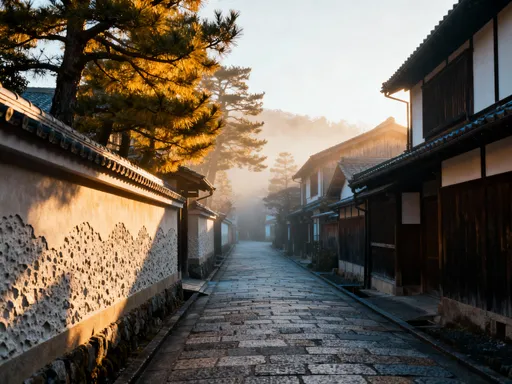
Just north of Kenrokuen lies Nagamachi, the historic district where lower-ranking samurai once lived under the service of the Maeda clan. Today, it stands as one of Japan’s best-preserved samurai neighborhoods, a quiet labyrinth of narrow lanes, thick clay walls, and modest wooden homes. The architecture here is both functional and symbolic. The distinctive *namako-kabe*—black plaster walls with a grid pattern resembling the skin of a sea cucumber—were designed to resist fire and signal social status. Inside, homes were built for discipline, not luxury. Sliding *fusuma* doors, hidden storage spaces, and small, sunken hearths reflect a life of simplicity and order.
Visitors can step into the Nomura Family House, one of the few samurai residences open to the public. Shoes are removed at the entrance, a small act that immediately shifts the experience from tourist observation to respectful immersion. Inside, the rooms are serene, with hand-painted sliding doors depicting cranes and pine trees—symbols of longevity and resilience. A hidden tea alcove, or *mizuya*, tucked behind a sliding panel, hints at the quiet rituals that once took place here. Unlike the opulent castles of other Japanese cities, this home speaks of restraint, duty, and quiet dignity. There are no grand halls, no lavish decorations—only the careful arrangement of space that reflects a life guided by principle.
What makes Nagamachi remarkable is that it is not frozen in time, but gently moving through it. While some homes have been converted into museums or cultural centers, others remain private residences. Locals walk these lanes every day, children pass by on bicycles, and laundry flutters from back porches. History is not behind glass; it is lived. This continuity creates a sense of reverence without pretense. There are no reenactments, no costumed performers—just the quiet hum of daily life continuing in a place where centuries of tradition are woven into the fabric of the present. To walk through Nagamachi is to understand that heritage is not always loud or grand. Sometimes, it is the silence between footsteps on a stone path, the weight of a wooden door, the way light falls through a paper screen.
Crafting Gold: The Art of Kanazawa’s Kaga Haku
Kanazawa’s reputation as a center of craftsmanship is perhaps best embodied in its gold leaf production. The city produces over 99% of Japan’s gold leaf, a staggering dominance rooted in centuries of tradition and innovation. Known locally as *Kaga haku*, this ultra-thin material is made through a meticulous, hand-driven process called *uchiwa-kin*. Pure gold is layered with washi paper and repeatedly hammered by skilled artisans using wooden mallets, a process that can take weeks to produce sheets just 1/10,000th of a millimeter thick. The result is not gilding for show, but a medium of reverence, used to honor temples, elevate cuisine, and adorn everyday objects with quiet dignity.
Visitors can witness this artistry firsthand in the small ateliers of the Higashi Chaya district. Behind unassuming storefronts, artisans work in near silence, their movements precise and meditative. Some studios offer hands-on experiences, allowing guests to try gold-leafing a small item—perhaps a wooden coaster, a ceramic cup, or a piece of lacquerware. The process is delicate; a single breath can send the fragile sheet fluttering away. This fragility underscores the skill required: steady hands, patience, and an almost spiritual focus. It is not manufacturing—it is transformation, turning a precious metal into something so thin it seems to dissolve into light.
The influence of gold leaf extends far beyond the workshop. It adorns the gates of temples, glimmers on the surface of *kaiseki* dishes, and even appears on local sweets like gold-leaf ice cream and matcha cookies. Yet, despite its ubiquity, the use of gold in Kanazawa is never ostentatious. It is not about wealth, but about honoring the moment, elevating the ordinary into the sacred. A bowl of soup becomes a work of art; a simple teacup becomes a keepsake. This philosophy reflects a deeper cultural value: that beauty and meaning are found not in excess, but in attention to detail, in the care with which something is made and presented. To see gold leaf in Kanazawa is to understand that true luxury is not loud—it is quiet, intentional, and deeply human.
Chaya Districts: Tea Houses With Stories Behind the Screens
Kanazawa’s cultural richness is perhaps most visible in its chaya districts, the historic entertainment quarters where geisha, known locally as *geiko*, have performed for centuries. The Higashi Chaya district is the largest and best-preserved of these, a neighborhood of two-story wooden *machiya* houses with latticed windows and narrow verandas. By day, the area feels tranquil, almost sleepy, with tea houses opening their doors to visitors sipping matcha and sampling delicate *wagashi* sweets. But at dusk, a subtle shift occurs. The lights dim, the doors close, and the soft notes of the shamisen—a three-stringed instrument—drift from behind paper screens.
Unlike the more famous Gion district in Kyoto, Higashi Chaya does not cater to spectacle. There are no staged performances for tourists, no photo ops with geiko in full regalia. The art here is private, reserved for invited guests in intimate gatherings called *ozashiki*. Geiko are not entertainers in the Western sense; they are highly trained artists skilled in music, dance, conversation, and the rituals of traditional hospitality. Their presence is subtle, their movements graceful, their role not to dazzle, but to create harmony in a gathering. To witness them, even from a distance, is to glimpse a world where refinement is not performed, but embodied.
One of the most evocative places in the district is the Shima Teahouse, a restored *ryōtei*—a high-end traditional restaurant—that now serves as a museum. Inside, visitors can explore velvet-lined reception rooms, hidden staircases, and private chambers where merchants, artists, and even politicians once gathered. The craftsmanship is extraordinary: hand-carved woodwork, silk wall coverings, and *fusuma* paintings depicting seasonal landscapes. Every detail was designed to impress, to create an atmosphere of exclusivity and elegance. But more than that, the teahouse stands as a testament to a culture that values discretion, privacy, and the quiet exchange of ideas. In a world of oversharing and constant visibility, Higashi Chaya reminds us that some experiences are meant to be rare, intimate, and protected from the public eye.
Offstage Encounters: Living Culture Beyond Tourist Trails
Beyond the curated beauty of gardens and tea houses, Kanazawa’s true character emerges in its everyday spaces. The Omicho Market, a bustling morning market that has operated for over 200 years, is a sensory immersion into local life. Fishermen shout prices as they unload the day’s catch—silver mackerel, plump scallops, glistening sea urchin. Grandmothers haggle over prices, their baskets filling with fresh vegetables, pickles, and steaming bowls of *oden*. Small stalls serve *kaisendon*, a rice bowl topped with a rainbow of raw seafood, eaten standing at a counter. This is not a market for tourists; it is where locals shop, eat, and connect. The energy is vibrant, the flavors bold, the pace unhurried.
Another hidden gem is Myoryuji Temple, popularly known as *Ninja-dera*—the Ninja Temple. Built in the 17th century as a disguised fortress, it was designed to protect the Maeda clan from spies and assassins. What appears from the outside as a modest temple conceals a labyrinth of secret passages, hidden doors, trapdoors, and escape routes. Visitors can climb narrow staircases, peer into false walls, and descend into underground chambers, all while learning about the ingenious defensive strategies of the Edo period. Unlike typical temples focused on worship, Myoryuji is a puzzle, a physical manifestation of historical tension and ingenuity. It is also a reminder that Kanazawa’s past was not always peaceful—behind its serene surface, there were secrets, strategies, and survival.
Equally revealing are the small *sando* shrines scattered throughout the city. These modest Shinto shrines, often no larger than a closet, are tucked into alleyways, beneath trees, or beside homes. Locals pause on their way to work to toss a coin, ring a bell, and offer a quiet prayer. There is no ceremony, no audience—just a personal moment of connection with the unseen. These shrines are not tourist attractions; they are part of the spiritual rhythm of daily life. They reflect a culture where faith is not grand or dramatic, but woven into routine, a quiet acknowledgment of forces beyond human control. To see these moments is to understand that Kanazawa’s soul is not in its monuments, but in its movements—in the way people live, believe, and remember.
Why Kanazawa Changes How You Travel
Kanazawa does not announce itself. It does not demand attention with neon signs or crowded attractions. Instead, it invites you to lean in, to listen, to slow down. In an age of travel defined by checklists, photo ops, and social media highlights, Kanazawa offers a different model—one rooted in presence, patience, and quiet observation. There is no rush here. You can spend an hour watching a lacquerware artisan sand a single box, each stroke deliberate, each motion honed by decades of practice. You can sit in a garden and watch the light change over an hour, the shadows shifting, the water rippling. These are not inefficiencies—they are the essence of the experience.
The city teaches a different kind of awareness. It shows that culture is not something to be consumed, but felt. It is in the weight of a wooden door, the sound of a broom on gravel, the way a craftsman’s hands move without thought. Kanazawa reminds us that the most meaningful journeys are not those that fill our cameras, but those that fill our attention. They are not about collecting sights, but about cultivating stillness. Once you have heard the whispers of this city—the soft chime of a temple bell, the rustle of gold leaf, the quiet footsteps on a samurai lane—your idea of travel begins to shift.
You stop chasing destinations. You start seeking depth. You realize that the best places are not the loudest, but the ones that allow you to hear yourself think. Kanazawa does not give up its secrets easily. But for those willing to walk slowly, to listen closely, and to respect the quiet dignity of its traditions, it offers a rare gift: the chance to travel not just across geography, but into the heart of what it means to live with intention, beauty, and continuity. In a world that moves too fast, Kanazawa stands as a quiet testament to the enduring power of slowness, craftsmanship, and the unseen threads that connect us to the past.